
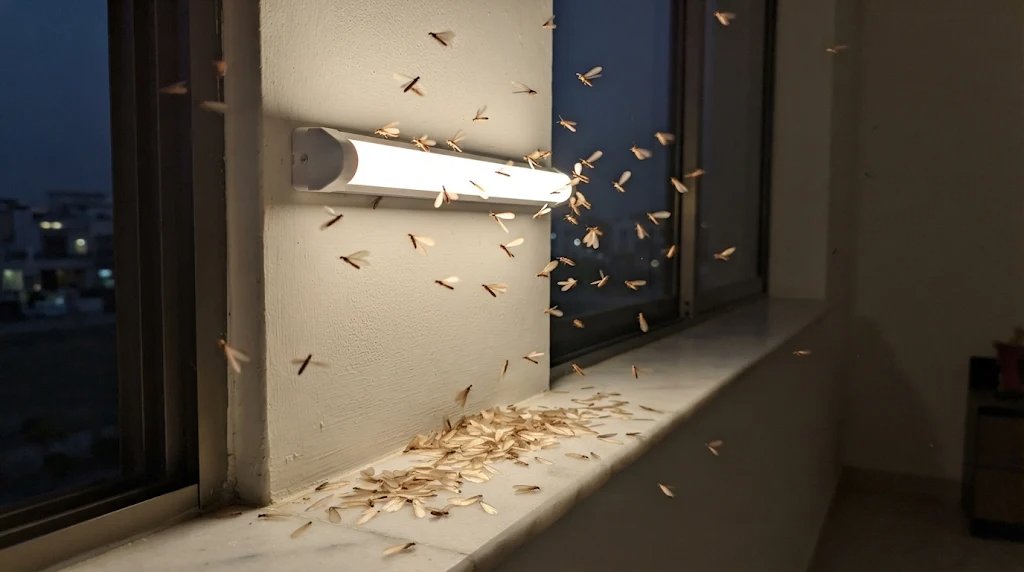
You switch on the lights one evening after rain and suddenly see dozens of small winged insects around the bulb, then a pile of wings on the window sill the next morning. These are most likely flying termites, and they are one of the clearest warnings that a termite colony is active in or near your house. In Pakistan they appear mostly after the first spring showers and during the monsoon. This guide explains what flying termites mean, how to tell them apart from flying ants, and what termite treatment step to take next.
What Are Flying Termites?
Flying termites (also called swarmers or alates) are the reproductive members of a mature termite colony. When a colony grows large enough, usually after three to five years, it releases winged males and females to start new colonies. They fly for a short time, drop their wings, pair up and look for moist wood or soil to begin a new nest.
So a swarm is not the start of a problem. It is a sign that a strong, established colony already exists close by, often under the floor, inside a wall cavity or in the woodwork of the house.
Why Do Flying Termites Appear in the House?
Swarmers come out when warmth and humidity are just right, which is why you mostly see them on a calm evening right after rain. In cities like Lahore, Islamabad, Rawalpindi and Karachi, the peak season is from March to May and again from July to September.
Inside a home they are drawn to light, so they gather around tube lights, window glass and door gaps. If you find them indoors in large numbers, especially in a closed room, the colony may be inside the building itself rather than in the garden or lawn.
Flying Termites vs Flying Ants: How to Tell Them Apart
Many people confuse flying termites with flying ants. The difference matters, because ants are a nuisance while termites damage the wooden structure of your house.
- Waist: termites have a thick, straight body; ants have a narrow, pinched waist.
- Wings: termite wings are all the same length and much longer than the body; ant wings are uneven in size.
- Antennae: termite antennae are straight and bead-like; ant antennae are bent at an angle.
- Shed wings: termites drop their wings quickly, so piles of identical wings near windows usually point to termites.
What Flying Termites Mean for Your Home
Seeing termites in house rooms after a swarm means the worker termites of the same colony may already be feeding on the fixed woodwork of your home. Termites eat wood from the inside, so the surface often looks fine while the inside becomes hollow.
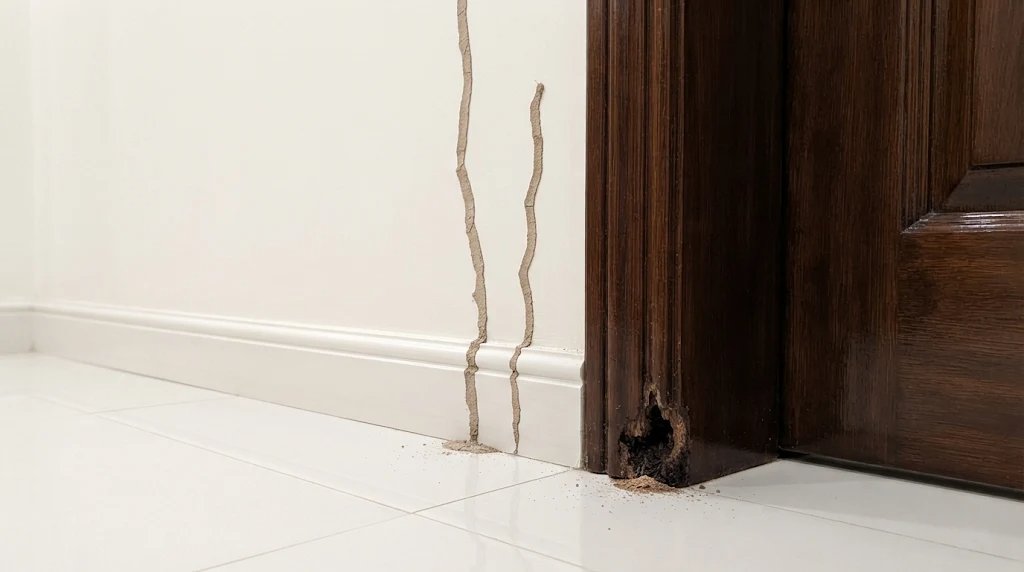
The areas most at risk are door frames (chaukhat), built-in almirahs and wardrobes, kitchen cabinets and wooden wall panelling. Termites cannot eat concrete, but they build thin mud tubes along concrete walls to travel safely from the soil to the wood.
Other Signs of Termites to Check Right Away
After you see flying termites, walk through the house and look for these signs. Finding even one of them means you should book a professional termite inspection.
- Thin, earth-coloured mud lines running up concrete walls, pillars or along the skirting.
- Door frames that sound hollow when tapped or feel soft at the bottom corners.
- Damage inside wardrobes, starting at the back panel and inner frame.
- Small holes or powdery soil coming out of kitchen cabinet joints.
- Doors and almirah shutters that suddenly become tight or hard to close.
What to Do When You See Flying Termites
Quick and correct action limits the damage. Here is what our technicians advise homeowners to do on the same day.
- Do not panic or spray randomly. Household insect sprays kill the swarmers you can see but do not reach the colony.
- Collect a few wings or insects in a clear bag or take a photo. This helps confirm they are termites.
- Switch off unnecessary lights in the evening to reduce the swarm indoors.
- Note where they came from: a door frame, a wall crack, a floor joint or a cupboard.
- Book a termite inspection so the source of the colony can be found and treated.
How Professional Termite Treatment Works
A swarm tells you the colony is mature, so a proper termite treatment must protect both the soil under the house and the affected woodwork. A standard deemak control job by Kaufmann covers three steps.
- Inspection: the technician checks door frames, wardrobes, kitchen cabinets and walls to find the active areas and the entry points.
- Soil barrier along walls: small holes are drilled into the floor along the inside of the walls, about two to three feet apart, and a termiticide is injected to create a barrier in the soil. The holes are then filled neatly to match the tiles.
- Wood treatment: infested door frames are injected through small holes, and wooden surfaces inside wardrobes and cabinets are sprayed to stop further feeding.
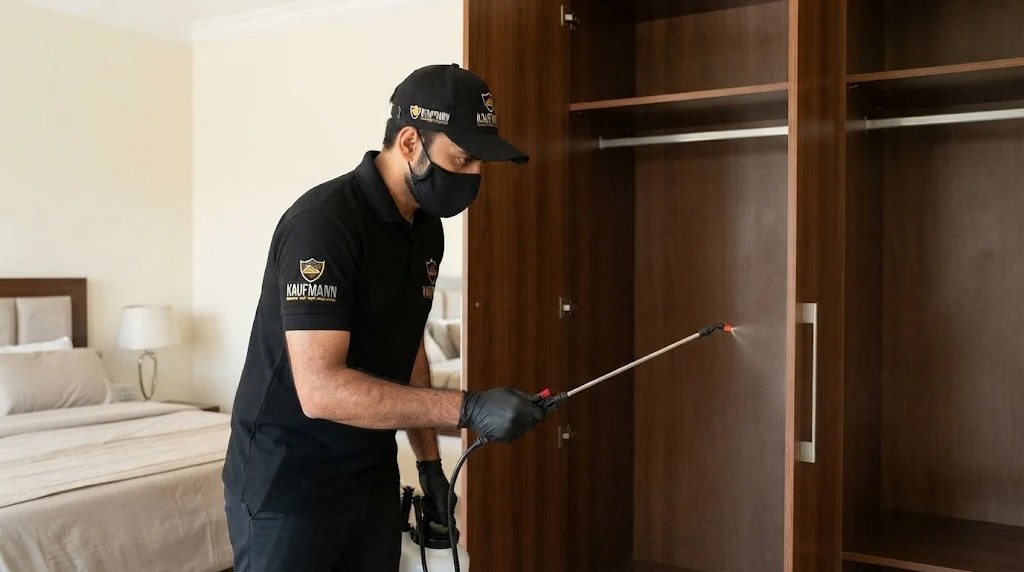
Our termite control services come with a written warranty, and the chemicals used are imported from trusted manufacturers.
Can You Stop Flying Termites at Home Yourself?
You can reduce the risk, but home remedies will not remove an established colony. Keep these habits after treatment to make your home less attractive to termites.
- Fix leaking pipes, bathroom seepage and roof leaks, since termites need moisture.
- Keep wood, cardboard and old furniture away from walls in stores and basements.
- Keep plant beds and soil from touching wooden frames near the ground.
- Get a yearly termite inspection, especially before the spring and monsoon seasons.
Flying Termites in Lahore, Islamabad and Karachi Homes
Older houses with wooden door frames and newer homes with heavy built-in woodwork both see swarms every year. Kaufmann has offices in Rawalpindi, Lahore, Karachi and Hyderabad (Sindh), and our teams handle termite treatment for homes, offices and commercial buildings across these cities. See our pages for termite control in Lahore and termite control in Islamabad.
Frequently Asked Questions
Are flying termites dangerous?
Flying termites do not bite or spread disease. The danger is to your home: a swarm shows a mature colony nearby that may already be damaging door frames, wardrobes and cabinets.
Do flying termites mean my house is infested?
Not always, but a swarm inside a closed room usually means the colony is in or under the building. A professional termite inspection is the only reliable way to confirm it.
How long does a flying termite swarm last?
A swarm usually lasts from a few minutes to an hour, mostly in the evening after rain. The swarmers lose their wings quickly, but the colony that released them remains active.
Will killing flying termites solve the problem?
No. Spraying the swarmers only kills the insects you can see. The colony stays in the soil or woodwork, so a full termite treatment is needed.
When is the best time for termite treatment?
The best time is as soon as you see flying termites or any other sign. Treating before the next swarm season stops the colony from spreading to more woodwork.
Udne wali deemak ka ilaj kya hai?
Udne wali deemak ghar ke paas deemak ki colony ki nishani hai. Sirf spray kafi nahi; deemak ka pakka ilaj ke liye professional inspection, deewaron ke saath soil treatment aur lakri ka treatment zaroori hai.
Book a Termite Inspection Today
If you have seen flying termites or shed wings in your home, do not wait for visible damage. Kaufmann has protected homes and businesses across Pakistan since 2006. Book a free termite inspection and our team will find the source and recommend the right treatment.
Recent Comments