
Every year, thousands of Pakistani homeowners discover the same thing at the same moment: the first heavy monsoon shower, and a dark patch spreading across the ceiling. By then the water has already been travelling through the slab for months. It just needed enough volume to become visible.
This guide explains where building water damage actually begins, which treatment suits which problem, and how to judge whether a waterproofing company knows what it is doing before you hand over your building.
Why Buildings in Pakistan Leak More Than They Should
Our climate is unusually hard on structures. Summer surface temperatures on an exposed roof slab can cross 70°C, then drop sharply during a night storm. That expansion and contraction cycle opens hairline cracks in concrete every single season.
Add to this three common construction shortcuts. First, plaster applied directly over unprimed brickwork with no damp-proof course at plinth level. Second, bathrooms tiled over screed with no membrane beneath. Third, roof slabs finished without any slope, so rainwater sits in pools for days instead of draining.
None of these fail immediately. They fail in year three or year four, which is exactly why most owners blame the weather rather than the original workmanship.
Where Water Damage Usually Starts
Roof and Terrace
The roof takes the most abuse and is where most roof leakage complaints begin. Ponding water finds the weakest point — usually a construction joint, a parapet junction, or the gap around a drain outlet. Proper roof waterproofing is not just a coating; it requires slope correction, joint treatment, and edge detailing at every upstand. Roof and terrace waterproofing on accessible rooftops also needs a protective screed or tile layer, because foot traffic destroys unprotected membranes within two seasons.
If you have already noticed staining, roof leakage treatment should happen before the next monsoon. Water sitting inside a slab corrodes steel reinforcement, and that damage is structural, not cosmetic.
Walls
Wall seepage treatment is the most misdiagnosed job in the industry. Damp appearing on an internal wall can come from four completely different sources: a leaking pipe inside the chase, water tracking down from the roof, moisture crossing from a neighbouring boundary wall, or rising damp pulling groundwater up through the foundation by capillary action.
Painting over it solves nothing. Wall waterproofing only works once the actual path has been identified. Wall seepage and cracks on external elevations usually need crack sealing followed by an elastomeric external coating; rising damp needs chemical injection at plinth level instead.
Bathrooms
Bathroom leakage shows up on the ceiling of the room below, often several metres away from the real source. Proper bathroom waterproofing means a membrane under the tiles across the full floor and up the wet walls to at least 900 mm, with extra attention at floor traps and pipe penetrations.
Retrofitting is possible without complete demolition in many cases, but genuine bathroom waterproofing services require identifying whether the cause is the membrane, the grout line, or simple plumbing leaks behind the wall. Three different problems, three different fixes.
Basements
Basement waterproofing is the most technically demanding category because water pressure pushes inward rather than draining away. Negative-side treatment using crystalline or cementitious waterproofing systems, combined with injection grouting at active leak points, is standard practice. Drainage design matters as much as the coating itself.
Water Tanks
Water tank waterproofing carries a requirement the others do not: whatever you apply will be in permanent contact with drinking water. Only certified food grade lining should be used. Water tank leakage also wastes a significant volume every month, which matters in areas already dealing with supply pressure problems.
Waterproofing Systems Explained
Choosing the right waterproofing system depends on the surface, the exposure, and the movement the substrate will experience.
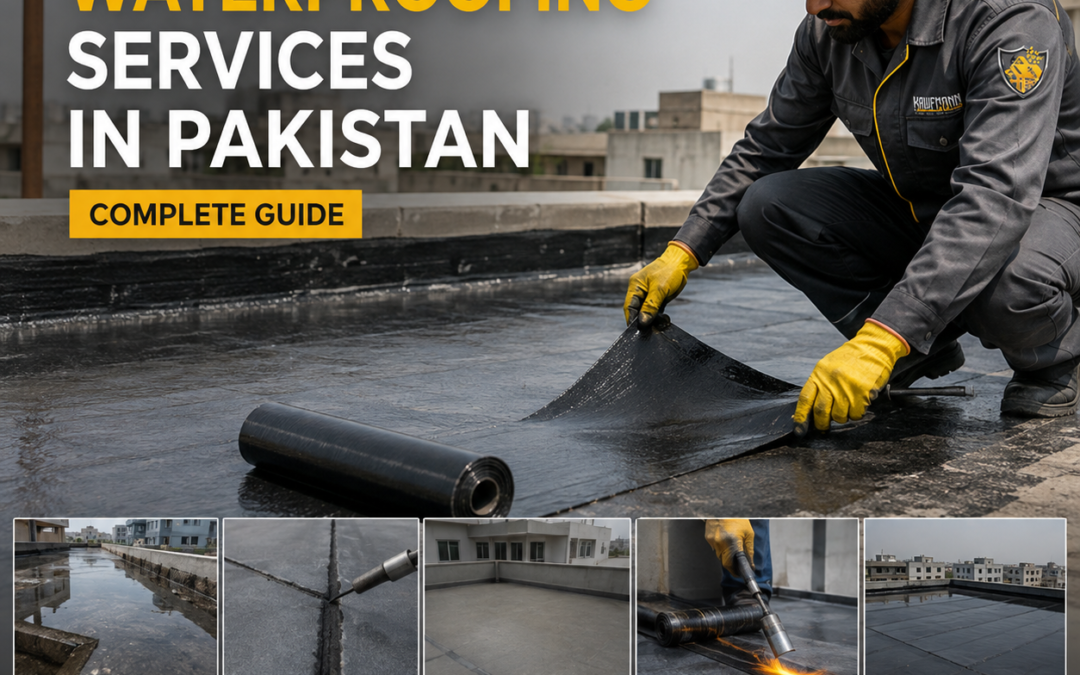
Bitumen membrane system — torch-applied sheets, still the workhorse for large exposed roofs. Strong, proven, and economical over big areas. Performance depends almost entirely on how well the overlaps and terminations are executed.
PU liquid waterproofing — a seamless liquid-applied polyurethane coating that cures into a flexible film with no joints. Excellent for complex roofs with many penetrations, parapets, and irregular shapes. PU coatings also bridge minor cracks as the structure moves.
Cementitious waterproofing — polymer modified cementitious systems bond directly to concrete and masonry. Ideal for tanks, basements, and any surface that will be tiled or plastered over afterwards.
Crack injection resins — epoxy or polyurethane resin pumped under pressure into active cracks. This is repair rather than prevention, and it is what makes crack sealing permanent instead of temporary.
Chemical barrier — injected horizontally into masonry to stop rising damp where no original damp-proof course exists.
Good contractors combine systems. A rooftop might use waterproofing membranes across the main field, PU detailing around drains, and a cementitious base coat over repaired sections. Anyone offering one product for every situation is selling stock, not solutions.
Regional Conditions Across Pakistan
Requirements shift meaningfully by city, which is why national-scale waterproofing contractors should adjust specification rather than repeat one method everywhere.
Waterproofing in Islamabad contends with heavy monsoon rainfall and a significant freeze-thaw risk during winter nights. Flexible systems that tolerate movement outperform rigid coatings here. Sloped-roof detailing and parapet junctions deserve particular attention.
Waterproofing in Rawalpindi frequently involves older construction with shared walls, where seepage crosses from a neighbouring property. Diagnosis matters more than product selection, and boundary-wall treatment is often unavoidable.
Waterproofing in Lahore deals with a high water table in several areas, making basement waterproofing and rising damp far more common than elsewhere. Extended monsoon exposure also puts real stress on roof systems.
Waterproofing in Karachi faces coastal salt-laden air, which accelerates corrosion and degrades certain coatings quickly. UV resistance and salt tolerance should be the first specification checks, not afterthoughts.
How to Evaluate a Waterproofing Contractor
Ask these questions before signing anything.
Did they diagnose before quoting? Any firm that quotes for roof waterproofing services without inspecting the roof is guessing. Correct diagnosis is most of the job.
What exactly is being applied? You should receive product names, coverage rates per square metre, and number of coats — not simply “chemical.”
How is surface preparation handled? Most failures trace back to preparation, not materials. Cleaning, crack repair, and priming should be itemised separately.
What does the warranty actually cover? A written warranty naming the treated area, duration, and exclusions is worth far more than a verbal assurance.
Have they handled your building type? Residential waterproofing on a single house is not the same discipline as commercial waterproofing on a warehouse. House waterproofing, office waterproofing, and room waterproofing each involve different access constraints, occupancy limitations, and curing schedules.
Prevention Costs Far Less Than Repair
The financial argument is straightforward. Treating a roof before failure is preventive maintenance. Treating it after two seasons of water ingress means dealing with corroded reinforcement, damaged plaster, ruined paint, and often electrical work as well.
Inspect your roof at the end of every monsoon. Look for ponding marks, hairline cracks, blistered coating, and blocked drain outlets. Check the ceiling of the room directly beneath the water tank. Run your hand along the base of external walls for cool, damp patches. Ten minutes of inspection can prevent a year of gradual damage.
Frequently Asked Questions
How long do professional waterproofing services last? It depends on the system and the exposure. A well-installed bitumen membrane system on a protected roof typically performs for 8 to 12 years, while PU liquid waterproofing commonly lasts 10 to 15 years with proper maintenance. Bathroom waterproofing installed beneath tiles can last the life of the installation if the membrane is continuous and correctly detailed. Surface preparation influences longevity more than the product brand does.
Can roof leakage treatment be done without breaking the existing floor? In most cases, yes. If the existing surface is sound, roof leakage treatment can be applied over it after cleaning, crack repair, and priming. Removal becomes necessary only when the old layer has debonded, when trapped moisture sits underneath, or when slope correction is required. A proper inspection determines this before work starts.
What is the difference between waterproofing and damp proofing? Waterproofing resists water under pressure — think water tank waterproofing or basement waterproofing holding back a water table. Damp proofing resists moisture movement without pressure, such as a damp-proof course stopping capillary rise through a foundation. Damp walls caused by rising moisture need a chemical barrier, whereas active leakage needs a full membrane system.
Get Your Property Inspected
Kaufmann Enterprises provides complete waterproofing services in Pakistan, covering waterproofing services in Lahore, waterproofing services in Islamabad, waterproofing services in Karachi, and waterproofing services in Rawalpindi. We manufacture our own waterproofing chemicals, which means full control over formulation, batch consistency, and supply.
Book a free site inspection today. Our technical team will identify the actual source of the problem, recommend the correct system for your structure, and provide a written warranty on the treated area.
Recent Comments